Real Estate Agent Time Management: Building a Workday Around the Business You Actually Have

VP of U.S. Operations
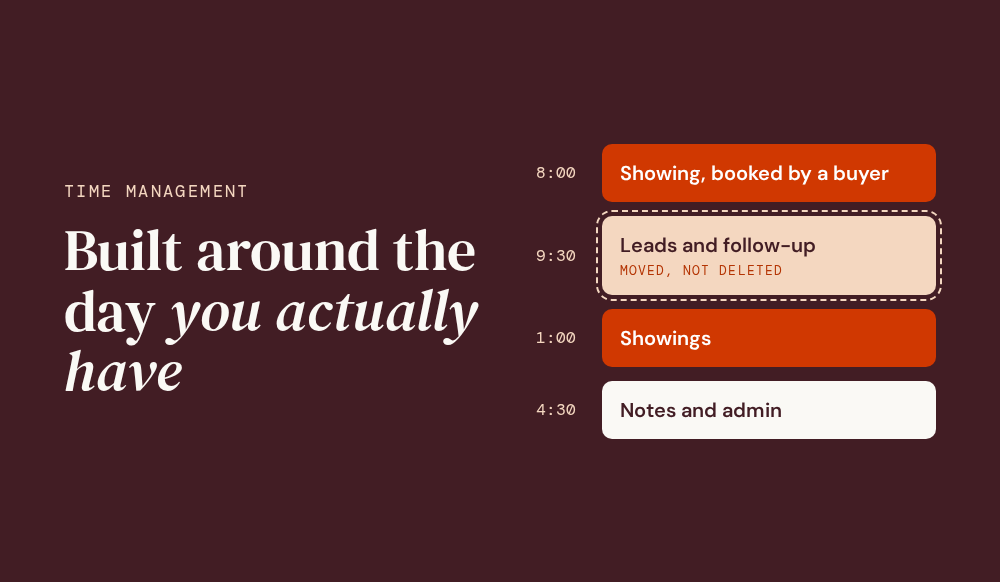
Most advice about real estate agent time management starts with a calendar. Block out your mornings, schedule your prospecting, set aside time for administrative work, and stick to the plan.
That sounds reasonable until you actually try running a real estate business.
Your buyer can only see properties after work. An inspection uncovers an unexpected problem. A seller wants to discuss a price reduction before the weekend. A lender needs documentation to keep a closing on schedule. Meanwhile, two new leads have come in, and you still haven't followed up with the people you met at Sunday's open house.
None of these situations is unusual. They're part of the business.
The challenge isn't simply finding enough hours in the day. It's managing competing priorities while protecting the activities that actually generate business.
Effective time management for real estate agents isn't about controlling every hour. It's about making sure the important work gets done, even when your schedule doesn't cooperate.
Why traditional time management doesn't work for real estate agents
Real estate has always been a relationship-driven business. Technology has changed how we find clients, market properties, and manage transactions, but it hasn't changed one fundamental reality: much of an agent's schedule revolves around other people's availability.
A buyer working a traditional nine-to-five job may only be available for evening showings. A seller may want to meet on Saturday morning. Inspections, appraisals, and closings come with schedules that agents don't always control.
And then there's the work that doesn't have an appointment attached to it.
Following up with a prospective seller. Staying in touch with past clients. Reaching out to someone considering a move next year. Updating contact records after a conversation. Remembering to send a contractor recommendation.
These activities are easy to postpone because they rarely feel as urgent as the transaction sitting in front of you.
Unfortunately, they're also the activities that help create your next transaction.
An agent can spend an entire day being busy without doing much to grow their business. That doesn't mean the work wasn't necessary. It means the immediate demands of the business can easily consume the time needed to build its future.
The goal is to find a workable balance.
Start by separating urgent work from revenue-producing work
Not everything on an agent's to-do list contributes equally to their business.
Some activities produce immediate opportunities. Others support existing transactions, maintain relationships, or keep the business operating.
All of them have a place, but they shouldn't carry the same priority.
Consider three categories:
- Revenue-producing activities: Prospecting, responding to new leads, following up with prospective clients, listing presentations, buyer consultations, and maintaining referral relationships.
- Client and transaction obligations: Showings, negotiations, inspections, contract deadlines, coordinating with lenders and escrow, and communicating with clients throughout a transaction.
- Administrative and operational work: Updating CRM records, organizing documents, preparing marketing materials, entering notes, coordinating schedules, and managing the systems that support the business.
The mistake isn't spending time on administrative work. It's allowing that work to consume the hours you could be spending with clients and prospective clients.
Think about an agent who spends an hour updating CRM records after a full afternoon of showings. Those records are important. The information needs to be captured. But does the agent personally need to spend an hour entering it?
That's a different question.
As technology improves, more administrative work can be handled without requiring agents to sit in front of a computer. The opportunity is to redirect that recovered time toward conversations and relationships.
Build your day around a few priorities, not a perfect calendar
A real estate schedule needs structure, but it also needs room to change.
Rather than accounting for every 15 minutes, establish a few recurring priorities that give your day direction.
Before 9 a.m.: Prepare for the day
The early morning is an opportunity to get organized before the demands of the business begin.
Review your appointments, check for urgent messages, identify approaching contract deadlines, and look at the people who need follow-up.
You should be able to answer a few simple questions:
Who needs to hear from me today? Which conversations could turn into business? What commitments have I already made? And what could prevent a transaction from moving forward?
The objective isn't to complete everything before 9 a.m. It's to start the business day knowing where your attention needs to go.
9 a.m. to midday: Focus on conversations that move the business forward
For many agents, the first part of the business day presents an opportunity to focus on lead response, prospecting, client follow-up, and scheduling appointments.
This is where consistency matters.
The new lead from yesterday deserves a response. So does the seller who asked you to check back after discussing a move with their family. Your past clients and referral network shouldn't disappear from your radar simply because you're working on active transactions.
Of course, this time won't always be available. A listing appointment or client obligation may take priority.
That's fine. The objective is to maintain the work, not defend an arbitrary time on the calendar.
Midday and afternoon: Appointments, clients, and transactions
Showings, listing presentations, inspections, vendor coordination, negotiations, and transaction work often occupy a significant portion of the day.
These are the activities that are difficult to schedule around a rigid productivity system because they depend on other people.
Build enough flexibility into your calendar to account for travel, appointments that run long, and the inevitable phone calls that come in between meetings.
Use smaller gaps to handle quick communications and capture information while it's fresh.
Don't assume every 20-minute opening is an opportunity to complete a major project. Sometimes it's simply the time needed to get to your next appointment.
After business hours: The second part of the real estate workday
For many agents, 5 p.m. isn't the end of the day.
It's when clients become available.
Evening showings, buyer consultations, listing appointments, community meetings, networking events, and industry functions are all part of a relationship-driven business.
That doesn't mean every agent needs to work every evening. It means an effective schedule should acknowledge these commitments and provide flexibility elsewhere in the week.
If you have three evening appointments, perhaps the next morning doesn't need to begin at 7 a.m.
Managing your time also means recognizing when to step away from the business.
For a more detailed example, see our real estate agent daily schedule, including a printable planner and checklist.
Make follow-up a priority, not something you do when there's time
Ask agents where their business comes from, and many will point to relationships, referrals, and repeat clients.
Now ask how consistently they follow up with those relationships.
That's where things often get complicated.
An agent might have hundreds or thousands of contacts spread across a CRM, email, phone, and various communication platforms. Some are actively looking to buy or sell. Others may not be ready for another year.
Keeping track of all those relationships requires more than remembering to make a few calls.
The problem isn't necessarily a lack of effort. It's that the information needed to maintain those relationships is scattered across different places.
A conversation happens by text. Another happens during a showing. Someone mentions an upcoming move at a community event. A past client asks for a contractor recommendation over the phone.
Each interaction creates information that may matter later.
When agents don't capture it, they're left relying on memory.
And memory becomes less reliable when you're juggling dozens of conversations.
The solution is to create one consistent process for identifying who needs attention and what needs to happen next.
That's where tools like The Librarian can help. Rather than requiring you to manually search through different systems, The Librarian helps organize information from client interactions, identify follow-up opportunities, and draft communications for your review.
Instead of beginning the day asking, "Who am I forgetting?" you can focus on the conversations that need to happen.
Stop saving data entry for the end of the day
Think about everything an agent learns during a typical showing.
The buyers don't like the kitchen layout. They're more concerned about commute times than they originally suggested. One of them mentions that their parents may eventually move in. They love the neighborhood but don't want a property that requires major renovations.
All valuable information.
Now imagine showing four more properties, taking several phone calls, and meeting another client before returning to your desk.
How much of that first conversation will you remember?
Traditionally, agents have been expected to collect information throughout the day and enter it into their systems later.
That's an inefficient way to work.
The better approach is to capture information when it happens.
Leave a voice note after the showing. Record the next step while you're still thinking about it. Capture the details of a conversation before moving on to the next appointment.
It doesn't need to be a polished report. It just needs to preserve the information.
The Librarian makes this easier by allowing agents to capture notes using natural language, including voice, while on the go. Those notes can be associated with client records without requiring the agent to return to a computer and manually enter everything.
Our guide to voice notes for real estate agents explores how this works.
The goal isn't to become faster at data entry. It's to eliminate as much unnecessary data entry as possible.
Use technology to reduce work, not create more of it
Real estate agents have access to more technology today than at any point in the industry's history.
CRM platforms, transaction management systems, electronic signatures, marketing software, MLS tools, email platforms, scheduling applications, and increasingly, AI assistants.
Each promises to make some part of the business easier.
But every additional system can also introduce another login, another workflow, and another place where information needs to be entered or maintained.
Over time, agents can find themselves spending a significant portion of the day managing the very technology that was supposed to save them time.
Technology should work within an agent's existing routine, not force the agent to build an entirely new routine around it.
This is an important distinction as artificial intelligence becomes part of real estate operations.
The most valuable applications of AI won't necessarily be the ones that introduce another dashboard or require agents to learn complicated new processes.
They'll be the ones that make existing work easier.
An agent should be able to finish a showing, capture what was said, identify the next step, and move on to the next appointment without having to open five applications.
That's the thinking behind The Librarian. It operates as an orchestration layer across the tools agents already use, connecting information, communications, and follow-up activities instead of trying to replace any system in their business.
The objective is simple: less time managing technology, more time working with people.
What happens when your schedule falls apart?
Eventually, it will.
A morning listing appointment runs long. An inspection reveals a problem. A client needs an immediate response. Suddenly, the three hours you planned to spend prospecting have disappeared.
Traditional productivity advice might tell you to move those tasks to another time block.
Sometimes that works.
But moving everything to tomorrow can quickly create a backlog that's impossible to manage.
A more practical approach is to reassess based on what actually matters.
First, address anything that affects an active transaction, contractual obligation, or client commitment.
Next, protect opportunities that are time-sensitive, particularly new leads and prospective clients who are actively considering a move.
Then identify the relationship-building activities that can reasonably be rescheduled without being forgotten.
Finally, decide which administrative tasks can be delegated, automated, shortened, or eliminated.
The important distinction is between postponing something intentionally and allowing it to disappear.
You may not get through every task on a difficult day. Many agents don't.
But you should still know what needs to happen next.
Review your business weekly, not just your calendar
A calendar tells you where you spent your time.
It doesn't necessarily tell you whether that time helped grow your business.
Set aside a short period each week to review both.
Look at the appointments you completed, the new opportunities generated, and the conversations that moved forward.
Consider which relationships need attention and which prospective clients have gone quiet.
Look at the administrative tasks that consumed your time. Are you repeating the same manual work every week? Is there something you could simplify or automate?
And consider how your schedule is affecting your ability to serve clients and maintain some balance outside work.
The point of a weekly review isn't to create another reporting obligation.
It's to identify what worked, what didn't, and what should change.
A good time management process evolves with your business.
The goal isn't to do more work. It's to make more of your work count.
Agents don't get paid for having the most organized calendar or completing the longest to-do list.
They get paid when transactions close.
But those transactions begin long before a contract is signed. They come from conversations, relationships, timely follow-up, and the trust built over months or years.
Good time management protects those activities.
It also recognizes that the business has changed. Agents no longer need to return to their desks to accomplish every administrative task, and increasingly, they don't need to handle every step manually.
The opportunity isn't simply to save a few minutes here and there.
It's to create a business where important information is captured when it happens, follow-up doesn't depend entirely on memory, and technology supports the way agents actually work.
You don't need another productivity system that falls apart by Tuesday. You need a workflow that works on Tuesday, even when everything changes.
That's what we're building with The Librarian. You can try it with a 30-day free trial.
Bring us one part of your workday you wish you could eliminate. We'll show you how to simplify it using the technology you already have.
See How The Librarian Helps You Close More Deals
Frequently asked questions
What is the best way for a real estate agent to manage their time?
Start by prioritizing revenue-producing activities, active client commitments, and transaction deadlines. Use a flexible daily structure rather than trying to schedule every hour. Capture client information as conversations happen and maintain a consistent follow-up process.
Should real estate agents use time blocking?
Yes, but with flexibility. Time blocking can help protect prospecting, follow-up, and administrative work. However, agents need to accommodate showings, inspections, client appointments, and other commitments that aren't always within their control. Focus on preserving priorities rather than rigid appointment times.
How much time should agents spend prospecting each day?
There isn't one number that works for everyone. A newer agent building a client base may need significantly more prospecting time than an established agent whose business comes primarily from repeat clients and referrals. What matters is maintaining consistent revenue-producing activity and measuring the opportunities it creates.
How can real estate agents reduce administrative work?
Start by identifying repetitive tasks, especially manual CRM updates, note-taking, scheduling, follow-up preparation, and information entered into multiple systems. Look for opportunities to simplify existing workflows or use automation and AI tools that integrate with the technology already in use.
How do agents keep track of clients and follow-ups while on the go?
Capture information immediately after conversations and appointments, ideally using tools that support voice notes and mobile access. Maintain a central process for tracking commitments and follow-up opportunities rather than relying on memory or scattered reminders. See our guide to follow-up reminders for real estate agents.
How do real estate agents balance evening and weekend appointments?
Recognize evening showings, weekend open houses, and networking commitments as part of the business when planning the week. Adjust preparation and administrative hours around those obligations, set reasonable boundaries, and avoid assuming that every workday needs to follow the same schedule.